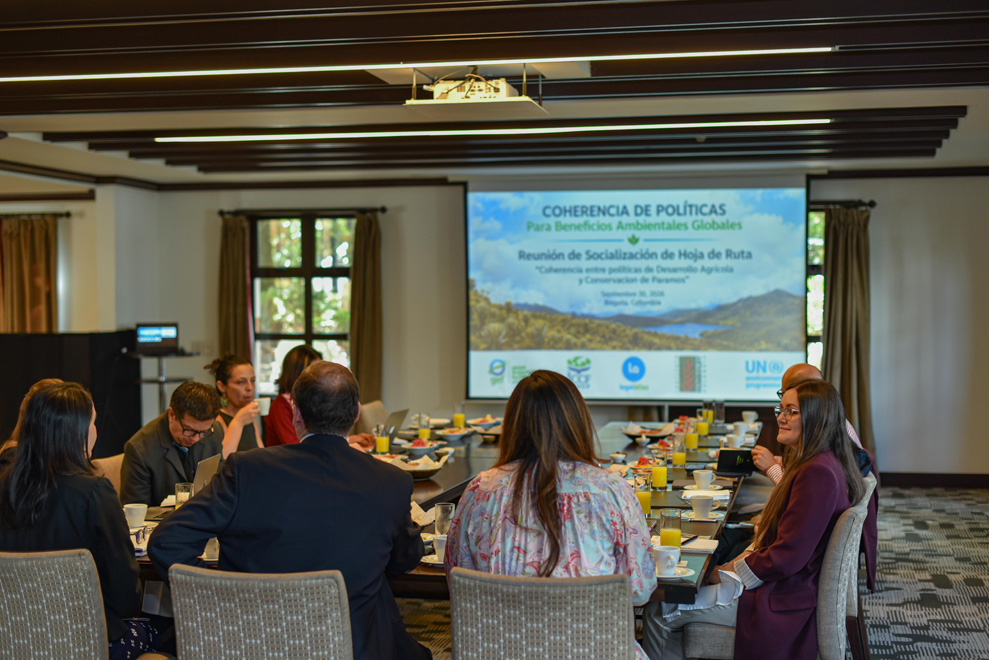
Bogotá, Colombia — ICCF Colombia hosted a series of meetings in Bogotá to share the results of a pilot project on policy coherence funded by the Global Environment Facility (GEF). The project examined how agricultural, conservation, and páramo management policies interact in Colombia’s high-altitude páramo ecosystems which supply much of the country’s fresh water. It analyzed 13 land-use conflicts across 11 páramo complexes and, through a national prioritization process, identified where overlapping or inconsistent policies most need to be resolved.
ICCF Colombia shared the findings with the National Planning Department (DNP), the Ministry of Environment and Sustainable Development, the Humboldt Institute, and the Association of Regional Autonomous Corporations (ASOCARS). Participants discussed the institutional challenges and opportunities the analysis revealed.
In a second session, ICCF Colombia shared the findings with members of the Conservation Caucus. Caucus members discussed the role legislators can play in implementation, coordination among institutions, and oversight.
Participants included:
- Senator Gonzalo Buate, Vice President of the Senate’s Fifth Committee (conservation and natural resources)
- Senator Santiago Montoya
- Representative Julio Roberto Salazar, President of the House’s Fifth Committee
- Representative Elizabeth Jay-Pang, President of the Second Committee (international affairs)
- Representatives Alejandro de la Ossa, James Mosquera, Ana Ligia Mora, Astrid Sánchez, and Francisco Vidal
The proposed roadmap outlines practical steps to strengthen the technical and legal framework for páramo management. It also aims to improve the operational and financial capacity of the joint bodies run by the regional authorities responsible for conservation. It calls for technical working groups, coordination across institutions, consultation with local stakeholders, and clear mechanisms for implementation and monitoring.
By bringing together Colombia’s conservation, agricultural, planning, and legislative institutions, these conversations lay the groundwork for clearer, more consistent rules. Such rules would give farmers and rural communities greater certainty while conserving the páramos.
ICCF Colombia will continue to support dialogue and coordination as the Colombian Government advances its priorities.
 Regional Headquarters