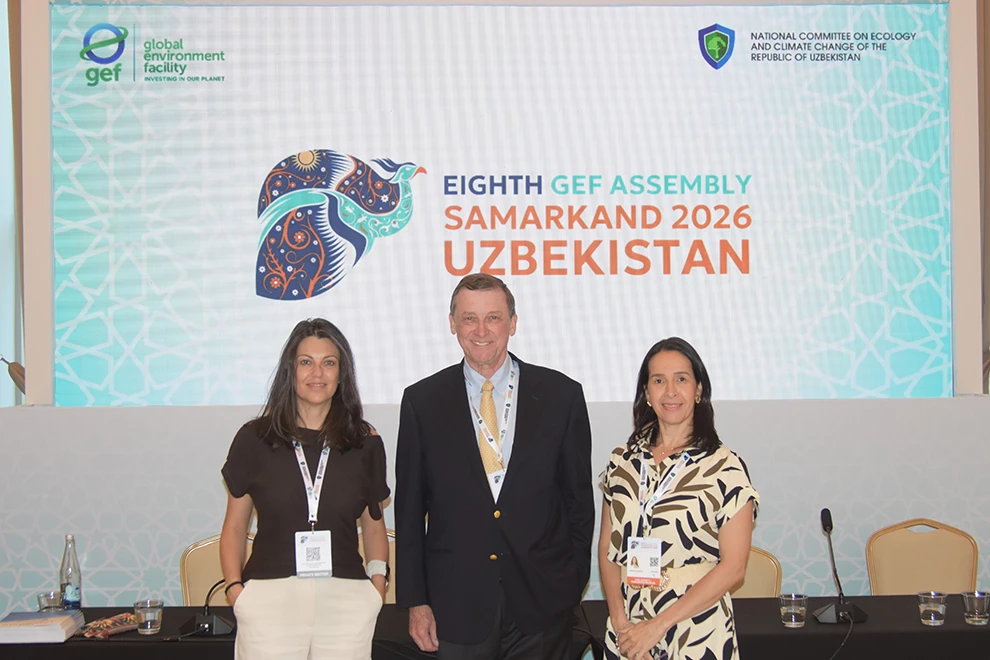
The ICCF Group organized the side event "Policy Coherence: From Theory to Practice" on 3 June 2026 on the sidelines of the 8th Global Environment Facility (GEF) Assembly in Samarkand, Uzbekistan. The event provided a platform to share lessons from the GEF-funded project Policy Coherence for Global Environmental Benefits, implemented by the ICCF Group in Colombia, Mongolia, and Zambia between 2024 and 2026.
Held as part of the wider 8th GEF Assembly, which brought together representatives from 186 member countries and a broad range of partners in Samarkand from 30 May to 6 June 2026, the side event contributed to ongoing discussions on how governance and financing can better support global environmental action. In this context, the ICCF Group highlighted the practical importance of aligning environmental, development, and sectoral policies to improve implementation on the ground.
A practical contribution to the policy coherence agenda
The event was convened to present and disseminate the publication Lessons and Recommendations for Grounding Policy Coherence, prepared by the ICCF Group and its technical partner Legal Atlas. The publication compiles lessons and recommendations emerging from the implementation of what the report describes as the first GEF-funded project focused specifically on policy coherence.
The session was presented by Jaime Cavelier and Edmilce Ugarte on behalf of the ICCF Group, together with María Pascual of Legal Atlas, and included an institutional welcome from Dikshya Devkota of the GEF Secretariat. The discussion focused on why policy coherence matters for biodiversity and sustainable development, and how countries can move from high-level commitments to concrete reforms and implementation pathways.
Lessons from three pilot countries
Drawing on experience in Colombia, Mongolia, and Zambia, the presentation highlighted ten lessons organized around three areas: design and methods, institutions and participation, and operational pathways. Among the key messages were the need for realistic timelines, careful sector selection, attention to secondary legislation and administrative instruments, and methods tailored to each country’s legal and institutional context.
The event also underscored that successful policy coherence work depends on identifying the right institutional entry points, engaging a broad set of stakeholders, and grounding analysis in local knowledge and practice. Speakers emphasized that early engagement in policy processes can improve outcomes, while artificial intelligence tools can help accelerate legal reviews and identify incoherences across large bodies of legislation.
Dialogue on implementation and next steps
The discussion that followed explored how these lessons can be applied in other countries and future GEF programming. Participants stressed the value of stakeholder mapping, the importance of political will from finance authorities, the central role of debates on policy trade-offs, and the need for stronger capacity-building to support implementation.
The side event brought together representatives from institutions including the GEF Secretariat, FAO, UNEP, UNDP, STAP, ministries, civil society organizations, and technical partners. This diversity of participants reflected the broader role of the GEF Assembly as a forum for governments, agencies, civil society, Indigenous Peoples, and other stakeholders to shape environmental priorities and partnerships.
Looking ahead
The Samarkand side event marked an important step in sharing ICCF’s experience on policy coherence with the wider GEF community. It also reinforced the relevance of policy coherence as a practical tool for delivering global environmental benefits through better-aligned laws, institutions, and public decision-making.
The ICCF Group and its partners will continue refining the publication as country-level pilots are finalized, with the aim of providing practical guidance that can inform future biodiversity policy and programming efforts.
 Regional Headquarters