Under the Advancing Conservation in the Eastern Caribbean Project, the ICCF Group is supporting initiatives to strengthen biodiversity conservation and heritage protection across the Eastern Caribbean. The project is funded by the Global Environment Facility (GEF) and implemented by the United Nations Environment Programme (UNEP).
In Saint Lucia, a key focus of the project (Component 2) is ecosystem conservation planning in the Dauphin (Iyanola) area in the northeastern region of the island, with particular emphasis on the Dauphine Estate. This site is widely recognized for its significant archaeological, historical, and ecological value, and is located adjacent to the Dauphin Beach Protected Area, including the historic Chimen Woyal Road.
A priority of the initiative is the development of an approach for establishing Voluntary Protection Agreements (VPAs) with private landowners. The VPA framework, under the provisions of the Forest, Soil and Water Conservation Act, provides a collaborative management mechanism through which landowners, government agencies, and stakeholders are incentivized to work together to conserve critical natural (including ecosystems and water resources) and cultural assets, while supporting opportunities for sustainable development such as heritage tourism, ecotourism, and agrotourism.
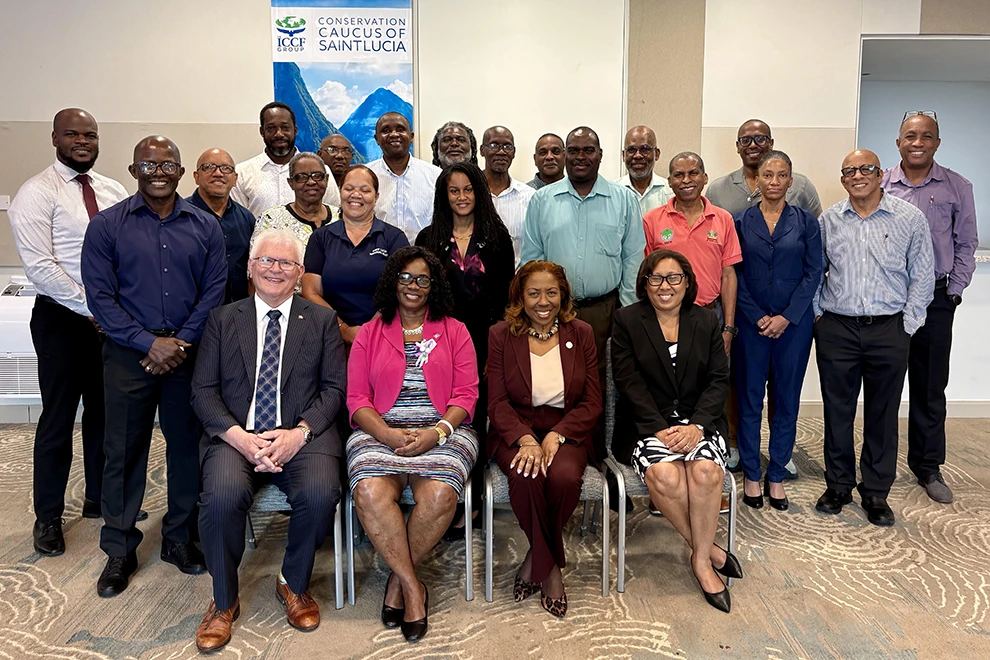
To advance this process, a Voluntary Protection Agreement (VPA) Stakeholder Workshop was convened on March 23, 2026, by the Saint Lucia Conservation Caucus (SLUCC), in collaboration with the Department of Sustainable Development within the Ministry of Agriculture, Food Security, Fisheries and Sustainable Development of Saint Lucia.
The workshop provided an opportunity to discuss modalities for advancing VPAs, share perspectives on conservation and development opportunities with landowners in the Dauphin and wider Iyanola area, and explore how relevant institutions can support implementation of this initiative.
Additionally, discussions focused on the upscaling of the VPA approach to support the conservation of critical landscapes under private ownership that function as water catchment areas, including those upstream of Water and Sewerage Company (WASCO) intakes. This issue is of particular national importance given the increasing pressures on water resources resulting from poor land management practices and extreme weather events.
Participation included Honourable Alvina Reynolds, President of the Senate and Co-Chair of the SLUCC, accompanied by five other Senators, Honourables Virginia Albert Poyotte, Embert Charles, Elisha Norbert, Ignatius Jean, and Tommy Descartes. Other participants comprised private landowners, representatives from relevant government ministries and agencies, and the national representative of UNESCO.
The workshop was moderated by Mr. Cletus Springer, an experienced national and regional public servant who has served as Permanent Secretary in several ministries, Advisor in Policy and Strategy Development with the Organisation of Eastern Caribbean States Secretariat, and Director of the Department of Sustainable Development at the Organization of American States. He currently serves as Chairman of the Caribbean Natural Resources Institute and as a member of the UNEP Expert Group on Vulnerability and Resilience in Small Island Developing States (SIDS).
ICCF Group expert consultant, Mr. Wayne Stetski, delivered a threefold intervention:
- introduction and presentation of the Voluntary Protection Agreement framework;
- facilitation of stakeholder inputs to further refine the draft VPA; and
- identification of opportunities to adapt and replicate the VPA model for similar conservation initiatives across Saint Lucia and the wider region.
At the conclusion of a highly productive session, the following recommendations were agreed:
- Refinement of the VPA Framework: Through the SLUCC, the VPA should be further refined in consultation with the Attorney General’s Office, the Saint Lucia National Trust, and the Forestry Department, to ensure legal coherence, institutional alignment, and operational clarity.
- Policy-Level Engagement: The SLUCC should spearhead the presentation of the VPA framework to Members of Parliament to build political support and facilitate formal adoption.
- Inter-Agency collaboration: The Water Resource Management Agency (WRMA), Forestry Department, Department of Sustainable Development, and WASCO should collaborate to explore the use of the VPA as a mechanism for advancing water security initiatives.
- Scaling and Replication: Further discussions should be pursued to support the application of the VPA approach to other comparable initiatives within Saint Lucia and, where feasible, across other OECS member states.
 Regional Headquarters