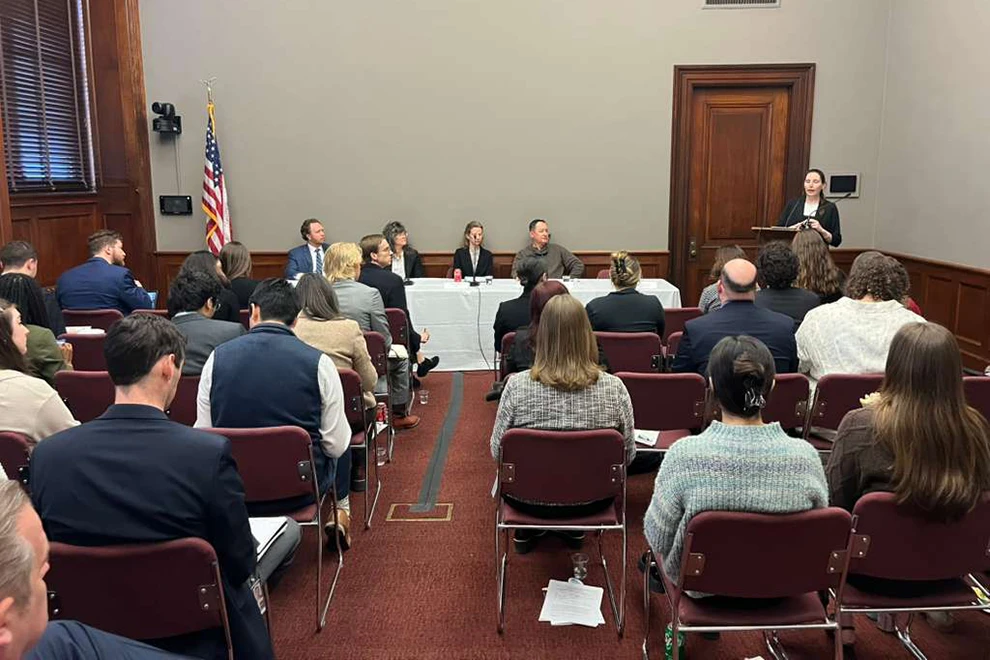
The Oceans Caucus Foundation is partnering with the Ocean Conservancy on a briefing series this year to celebrate the 50th anniversary of the Magnuson-Stevens Fishery Conservation and Management Act (MSA).
The first briefing, which took place on March 18th on Capitol Hill, shared perspectives on the MSA and why it was created in the first place, what makes it work, and what’s ahead.
The panel represented multiple stakeholder perspectives, consisting of Dr. Olaf Jensen, Fisheries Ecologist and Professor at the Center for Limnology and Department of Integrative Biology at the University of Wisconsin-Madison; Jamie Goen, Executive Director of the Alaska Bering Sea Crabbers and Member of the North Pacific Fishery Management Council; Capt. Scott Hickman, Owner and Operator of Circle H Charters in Galveston, TX; and Annie Hawkins, Chief of Strategy, National Oceanic and Atmospheric Administration (NOAA).
The panel was moderated by Meredith Moore, Senior Director of the Fish Conservation Program, who started off the discussion giving an overview of the MSA and the main reauthorizations that have taken place over the past 50 years. The bill started off with the intent to keep foreign fishing pressures out of U.S. waters and has morphed into an effort to maximize sustainable yield while conserving stocks and their ecosystems for future generations. This shift happened in the 1996 reauthorization when the restriction against overfishing was strengthened and formal rebuilding plans were implemented, resulting in 50 rebuilt stocks since 2000. It also added provisions protecting habitat, reducing bycatch, and supporting fishing communities. The most recent reauthorization in 2007 added best practices for using science to set catch limits.
The panelists unanimously agreed that what has made the MSA so successful over the years is the intentional effort of stakeholder inclusion in the management process. Eight Regional Fishery Management Councils were created, and each Council is responsible for developing fishery management plans for the fisheries in their region that require conservation and management. These management plans are designed to prevent overfishing, rebuild fish stocks, and protect, restore, and promote the long-term health and stability of U.S. fisheries. While each Council is unique, they all make management decisions through a transparent, collaborative, and science-based process. Annie pointed out that "the council process is the most important part" and reminded the group that there are no fisheries without fishermen. Captain Scott noted that Magnuson "serves the stakeholders, serves the fish, and serves the U.S." when highlighting the fishery management council process.
Science and stock assessments were also discussed and identified as playing an essential role in the management of fish stocks through regulatory measures like annual catch limits and seasonal closures. Contrary to popular belief, fishermen understand and support the use of stock assessments and, more importantly, participating in that process. Olaf highlighted that stock assessments are very transparent and that there is even an external peer review process as well as opportunities for fishermen to disagree with findings, whether they believe a stock is doing better or worse than an assessment finds, and for collaborative research. Fishermen have played an important role in data collection, whether offering a space on board their scheduled fishing outings or in response to fisheries disasters. Jamie noted that during the recent Alaskan Crab fishery collapse, Alaskan crabbers were ready to lend their services and partner with NOAA and researchers to figure out what was impacting the crab population at such a catastrophic level. Through collaborative efforts between stakeholders, they were able to mobilize funds within months to get the research endeavors underway.
All panelists agree that while not perfect, the MSA created a space for collaboration and a process that allows for management bodies to address the needs of specific fisheries. There is work to be done in order to be able to better serve the fishermen of tomorrow. Panelists pointed out the need for more data collection and science around fisheries and their changing ecosystems and are excited about the role AI, electronic monitoring, and eDNA can play. They also pointed out the need to create stability for family-owned waterfront businesses. That can be through an improved disaster relief process or looking at new models such as fisheries insurance.
We're looking forward to continuing these conversations over the course of the year and celebrating a law that, as Captain Hickman put it, has made us "the envy of the entire world. What a great piece of landmark legislation."
 Regional Headquarters