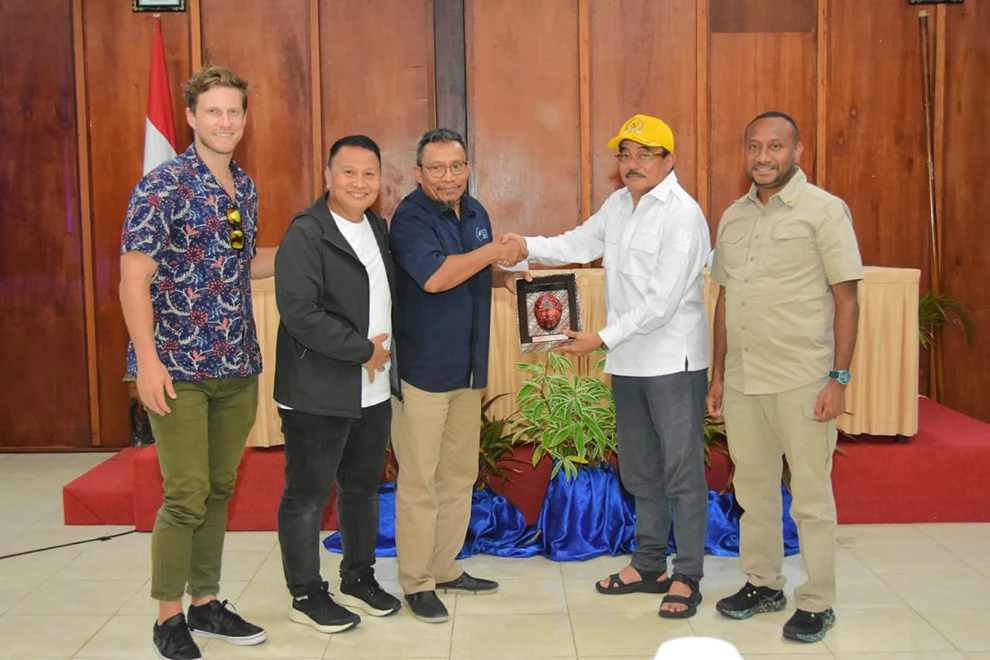
ICCF Indonesia supported caucus leadership in a focused dialogue with the Papua Barat Daya Provincial Marine and Fisheries Service (DKP) and the BLUD-UPTD Management Unit for Marine Protected Areas in Raja Ampat (BLUD-UPTD KKP Raja Ampat).
Waisai, Raja Ampat — As part of the field mission on sustainable marine conservation financing, ICCF Indonesia and the Working Committee on Blue Economy under BKSAP DPR RI held a focused dialogue with the Papua Barat Daya Provincial Marine and Fisheries Service (DKP) and the BLUD-UPTD Management Unit for Marine Protected Areas in Raja Ampat (BLUD-UPTD KKP Raja Ampat). The session highlighted Raja Ampat’s leadership in developing a sustainable, locally driven financing model for marine conservation.
Provincial Vision for a Blue Economy
DKP Papua Barat Daya presented the province’s long-term vision: “Southwest Papua as the Gateway to a Progressive and Sustainable Land of Papua, Built on a Blue Economy.” The province underscored its vast ecological and cultural assets, along with the need for stronger institutions, improved connectivity, and community-led economic opportunities to sustain one of the world’s richest marine regions.
BLUD Raja Ampat: Advancing Sustainable MPA Financing
Head of BLUD-UPTD KKP Raja Ampat, Mr. Syafri, outlined the financing and management system for the region’s 1.6 million hectares of marine protected areas. Supported by a full suite of provincial and national regulations, the BLUD framework enables diversified and transparent revenue streams, such as visitor fees, mooring permits, and service charges, reduces dependence on APBD, and facilitates partnerships with organisations such as KI, YKAN, WFF, and the Blue Abadi Fund.
At the operational level, Mr. Syafri underscored that MPA governance in Raja Ampat functions as a multi-stakeholder enterprise, grounded in long-standing customary authority and strengthened by provincial and national mandates. Indigenous communities remain central, tracing legitimacy back to the 2003 Tomolol Declaration, which articulated a collective commitment to responsible marine stewardship. This social foundation is complemented by a layered governance structure involving local government, conservation NGOs, and user groups, including tourism operators, homestay associations, and fisheries stakeholders, whose contributions are harmonised through ongoing dialogue and emerging coordination forums.
To maintain coherence across diverse interests, BLUD has initiated structured engagements with institutions such as the Majelis Rakyat Papua, DPR Papua Barat Daya, BRIN, and academic partners including UNIPA. These engagements underpin joint monitoring, baseline surveys, and supervision processes that ensure management decisions remain evidence-based and aligned with both scientific authority and customary expectations. Regular collaboration also sustains community-level capacity-building initiatives, from homestay quality upgrades to training for local guides and small-scale fishers, reinforcing local ownership while addressing persistent constraints in human resources, financing, and regulatory harmonisation.
A key initiative is the deployment of mooring buoys to prevent anchor damage at dive sites. Of the 170 moorings required, 56 locations have been surveyed, with installations financed jointly by BLUD and its partners.
Parliamentary Support for Strengthened Governance
The delegation, led by Hon. Mardani Ali Sera, Chairman of BKSAP DPR RI and Co-Chair of the DPR-RI Conservation Caucus, commended the strong cooperation between government, NGOs, and local communities.
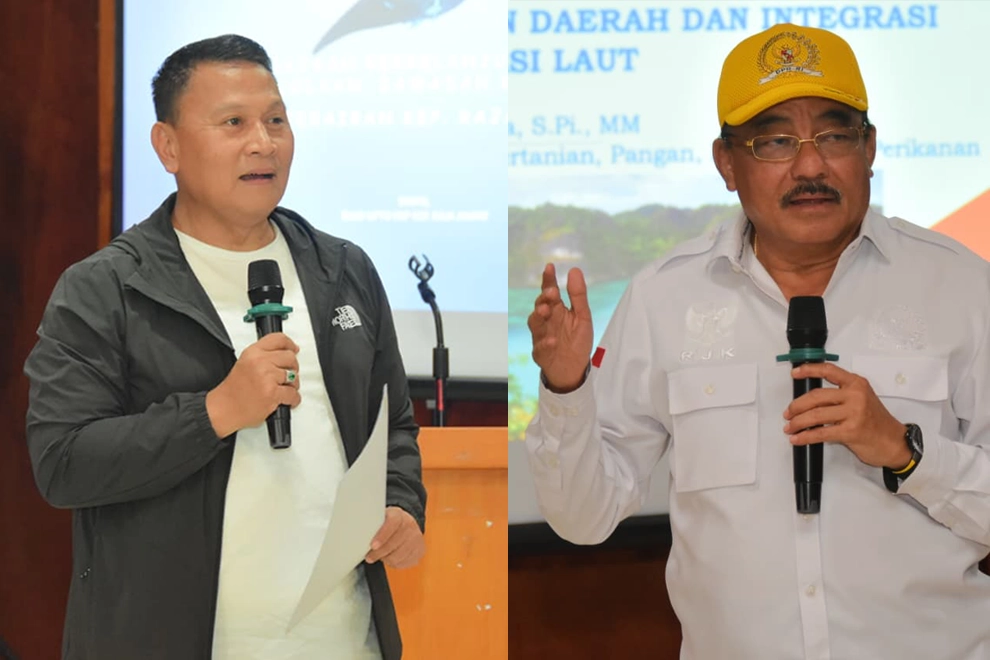
"I see an extraordinary collaboration between the local government, NGOs, and local communities — it is truly remarkable. Conservation cannot endure unless it is supported by a fair local economy."
ABOVE: Hon. Mardani Ali Sera and Hon. Robert Joppy Kardinal during the discussion with the DKP of Southwest Papua Province and BLUD-UPTD KKP Raja Ampat on November 11, 2025
He also emphasised the need for clear rules to manage increasing tourism pressure, expressing confidence that Raja Ampat’s well-functioning BLUD can help maintain a balance between conservation and economic development. “Raja Ampat must become Indonesia’s leading example of sustainable tourism,” he added.
Legislative Follow-Up Priorities
Discussions with DKP and BLUD also identified several priority issues that require legislative and senator-level attention moving forward. These include accelerating the passage of the Indigenous Peoples Bill (RUU Masyarakat Hukum Adat), strengthening national policies that mandate co-management approaches, particularly within strategic national projects (PSN), and establishing regular six-month briefings for legislators and senators to ensure they remain informed on developments, challenges, and local contexts in Southwest Papua and Tanah Papua.
Stakeholders also emphasised the need for clearer benefit-sharing mechanisms between village and provincial levels for resource-producing areas, as well as a review of land-use change policies within or adjacent to conservation zones, especially those that risk altering landscapes, ecosystems, and community livelihoods.
These priorities reaffirm the national relevance of the Raja Ampat BLUD model as a replicable approach to sustainable MPA financing and blue economy development. ICCF Indonesia will continue collaborating with DPR RI and provincial partners to advance marine governance reforms across the archipelago.
 Regional Headquarters